
The Shift: From Infinite Browsing to Direct Intent
For the past two decades, e-commerce has been defined by the “search and browse” model. Users type a query, get a list of links, and then manually navigate through multiple tabs to compare prices and specifications. Today, this model is reaching its breaking point. As consumers become accustomed to the instantaneous answers of generative AI, they are no longer willing to act as “search engine operators.”
TL;DR: The Essence
- UCP is the standard language for commerce-to-AI communication, backed by Google and Walmart.
- Agentic Commerce allows AI to buy on behalf of the user without visiting the store’s UI.
- 15–25% conversion growth is expected due to the total removal of checkout friction.
- Product Data (PIM) becomes more important than “Buy Now” button design.
- This is not an experiment—it is the infrastructure for a $5 trillion market.
We are moving from consuming static content to interacting with AI agents. In this new paradigm, the human doesn’t search for information—the agent synthesizes data and delivers a solution. This shift strikes at the very foundation of digital trade, ushering in the era of Agentic Commerce.
Agentic Commerce: When AI Takes Over the Cart
In traditional e-commerce, success is measured by on-site conversion. In the agentic era, the buying process is radically compressed. An AI agent (like Gemini) doesn’t just suggest which product to buy; it has the authority to execute the task on the user’s behalf: checking real-time inventory, negotiating a loyalty discount, and finalizing the payment.
For decision-makers, this means the traditional sales funnel is collapsing. The moment of inspiration becomes the moment of purchase. If your brand cannot “speak” directly to an AI agent, it becomes invisible to the consumer, who may never even visit your homepage.
Key Concept: The funnel is no longer a multi-step journey through a website; it is a single conversational turn between a user and an agent.
The “Babel Problem” and the Birth of UCP
Until now, every e-commerce ecosystem has been an island. Amazon, Shopify, and custom ERP systems use their own unique data structures and APIs. For an AI agent, integrating with millions of unique touchpoints was a technical impossibility.
To make agentic commerce viable, the industry needed the equivalent of TCP/IP for shopping—a universal standard for transmitting commercial intent. This is the Universal Commerce Protocol (UCP), officially launched in January 2026. Developed by Google in collaboration with industry giants like Shopify, Walmart, Etsy, and Wayfair, UCP establishes a common language for AI agents and business backends.
Online businesses must remain agile, ensuring they adopt this new protocol at the pivotal moment. The real question is: who will manage this new frontier? I believe SEO specialists are the natural choice to take the helm. Their mastery over structured data, schema markup, and search intent makes them, in my assessment, the most prepared to lead the transition into agentic commerce. This is no longer just about ranking; it is about managing the data that powers the world’s commercial AI agents.
SEO expert – Jakub Sawa (fratreSEO)
Under the Hood: Technical Foundations of Interoperability
UCP is not just another plugin; it is an abstraction layer over existing infrastructure. Its technical pillars include:
- Discovery Mechanism (
/.well-known/ucp): Merchants publish a JSON manifest at a standardized URL. This allows any AI agent to dynamically “discover” a store’s capabilities without manual integration. - Capabilities & Extensions: The protocol defines modular blocks such as:
shopping.checkout: Finalizing the transaction.shopping.discount: Handling promo codes and loyalty rewards.shopping.fulfillment: Managing delivery methods.
- Security & Verifiable Credentials (AP2): UCP works alongside the Agent Payments Protocol (AP2). Every transaction is backed by cryptographic proof of user consent, allowing secure payment tokens to pass between agents and processors like Stripe, Visa, or Adyen.
Business Perspective: Market Data and “First-Mover” Advantage
While the protocol is new, its market potential is massive.
- Conversion Lift: Early pilots show a conversion increase of 15–25%. By eliminating friction—no forms to fill, no logins required—the “abandoned cart” problem is significantly mitigated.
- Market Scale: Analysts from McKinsey and Bain project that agentic commerce will influence a market worth $3–$5 trillion by 2030.
- Consumer Readiness: Approximately 46% of consumers are already willing to delegate repetitive purchases (e.g., household goods, pet food) to an AI agent.
The “Frontend” Question: Is the Website Dead?
The most common fear is that UCP will render websites obsolete. The reality is a shift in roles, not extinction:
- The Website as a “Flagship Store”: Your site remains the place for brand storytelling, complex configurations, and high-touch customer service.
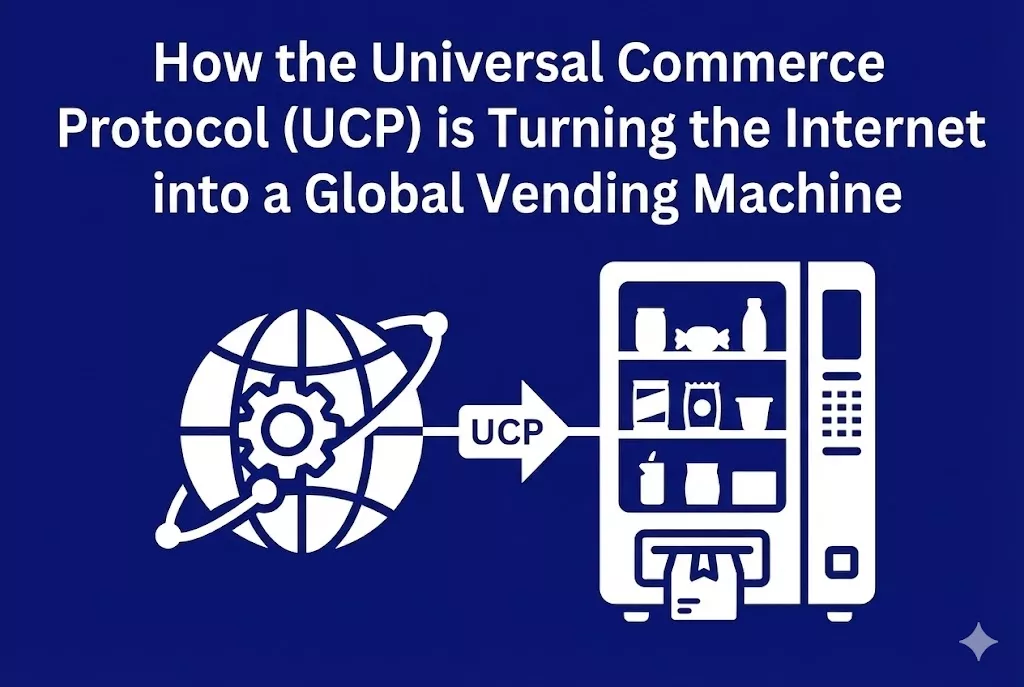
- The UCP Layer as a “Global Vending Machine”: Your backend becomes a high-speed engine that generates sales wherever the user is—be it in a chat interface, a voice assistant, or within a map application.
Adoption Timeline: 2026–2030
- 2026 (The Year of Integration): Major SaaS platforms (Shopify, BigCommerce) implement UCP natively. Google launches Direct Checkout in Gemini.
- 2027–2028 (Mass Adoption): Mid-sized retailers begin to see a decline in organic web traffic as transactions shift to AI interfaces.
- 2030 (The New Normal): Lacking UCP support is considered a “technical suicide,” similar to not having a mobile-friendly site in 2015.
Resources and Further Reading
- Google Developers: Under the Hood: Universal Commerce Protocol (UCP) – Technical deep-dive and implementation guide.
- Google Blog: New tech and tools for retailers in an agentic shopping era – Business announcement and platform overview.
- McKinsey & Co: The $5 Trillion Opportunity in Agentic Commerce – Market growth and economic impact analysis.
- Bain & Company: How Agentic AI Will Reshape Retail by 2030 – Strategic forecast for the retail sector.
- YouTube: Introduction to the Agent Payments Protocol (AP2) – Explaining the financial layer that powers UCP transactions.
Do you need an SEO Audit?
Let us help you boost your visibility and growth with a professional SEO audit.
Get in TouchNot getting enough traffic from Google?
An SEO Audit will uncover hidden issues, fix mistakes, and show you how to win more visibility.
Request Your Audit


